By 1781, Henry Lakes and Charles Rashleigh were acting for partners
connected with a new smelting house at Blowing House Hill in
St Austell. Fourteen years later, eleven signatories formally
agreed to continue the business of buying black tin, converting it
into white tin and carrying it into a wider commercial world.
178117951809
Smelting-house origins · Formal co-partnership · End of the
agreement’s named fourteen-year term
St Austell
Industrial centre
1781
Documented origins
11
Signatories in 1795
£52,347
Recorded joint capital
Principal records:
Kresen Kernow, CF/1/301, 17 July 1781
and
RD/1149, Articles of Co-Partnership, 5 May 1795.
Begin the exhibit
Industrial Context
Why Tin Mattered
Tin did not leave the mine as a finished commodity. It passed through
a connected chain of labour, transport, processing, capital and
commerce before reaching the workshops and markets where it could be
used. Smelting stood at the centre of that transformation, converting
prepared ore into a metal that merchants could sell and manufacturers
could put to work.
From the ground to the market
Each stage increased the value, usability or commercial reach of the
material.
01
Mine
Tin-bearing ore was extracted from underground workings or surface
deposits.
02
Dressing
The ore was crushed, washed and separated from as much waste rock
as possible.
03
Black tin
The concentrated tin ore became the raw commercial material bought
by smelters.
04
Smelting
Heat and fuel separated the metal from the remaining mineral
material.
05
White tin
Smelting produced metallic tin in a form ready for sale and further
manufacture.
06
Merchant
Merchants financed, purchased, transported and sold the finished
metal into broader markets.
07
Manufacturing and use
Tin entered workshops, foundries and factories as a coating, alloy
and working metal.
Where the metal went
Tin’s importance lay not only in the mine or smelting house, but in
the variety of objects, surfaces and commercial goods that depended
on its physical properties.
I
Tinplate and protective coating
Thin layers of tin helped protect iron surfaces from corrosion.
II
Solder
Tin-based mixtures joined metal components in practical and
manufactured objects.
III
Pewter and alloys
Tin was combined with other metals to create useful working
materials.
IV
Household and commercial vessels
Plates, cups, measures and containers brought tin into daily life.
V
Manufactured metal goods
Tin became part of a growing economy of finished, traded and
standardized goods.
Material and Energy
Coal supplied energy. Tin and copper supplied many of the materials
through which industrialization took physical form.
That broader Cornish mineral economy helps explain the commercial
environment in which merchants, landowners, professionals and
smelters operated. The surviving evidence for Sawle, Fox
& Co. nevertheless identifies a specific business in black tin,
smelting and white tin.
Industrial Origins
Before the Partnership: 1781
Fourteen years before the surviving co-partnership agreement, a lease
records a smelting house being built at Blowing House Hill in
St Austell. The document places John Sawle, Henry Lakes and Charles
Rashleigh within an already developing industrial enterprise.
Insert reproduction or representative crop of
CF/1/301 here
Kresen Kernow, CF/1/301.
Lease concerning land at Blowing House Hill, St Austell,
dated 17 July 1781.
17 July 1781
Lease of land at Blowing House Hill
A parcel of ground, formerly used as a garden, was leased for an
industrial site associated with the Old Blowing House.
Title
Lease, plot of ground formerly a garden, Blowing House Hill,
St Austell
Parties
John Sawle; Henry Lakes and Charles Rashleigh, acting on behalf
of their partners at the Old Blowing House
Reference
Kresen Kernow, CF/1/301
Interpretation
The lease shows that a partnered smelting operation was
already taking physical form in 1781. John Sawle supplied
land and water access, while Henry Lakes and Charles Rashleigh
acted for a wider group of partners.
Landowner
John Sawle
Representatives
Henry Lakes and Charles Rashleigh
Activity
Smelting house under construction
Term
Fifty years
Archival Extract
Water for the blowing house
Together with the liberty of taking and conducting such water as
might be required for the use of the blowing house through the land
belonging to John Sawle.
Editorial rendering of the water-rights provision in CF/1/301.
Replace this wording with the exact transcription from the original
document before final publication if the clause has been transcribed
in full.
What the record establishes
CF/1/301 establishes that an industrial partnership connected with
John Sawle, Henry Lakes and Charles Rashleigh existed by 1781. It
records land, water rights and a smelting house then under
construction, providing a clear earlier foundation for the world in
which the 1795 agreement later appeared.
It also shows that the enterprise was collaborative from the outset.
Lakes and Rashleigh were not acting only for themselves, but
on behalf of partners associated with the Old Blowing
House.
Evidential Caution
The lease does not, by itself, prove that the 1781 partnership and
Sawle, Fox & Co. as constituted in 1795 were legally identical.
It demonstrates continuity of people, place and industrial activity,
but the precise legal and commercial relationship between the two
enterprises remains a question for further research.
The Foundational Artifact
The 1795 Co-Partnership Agreement
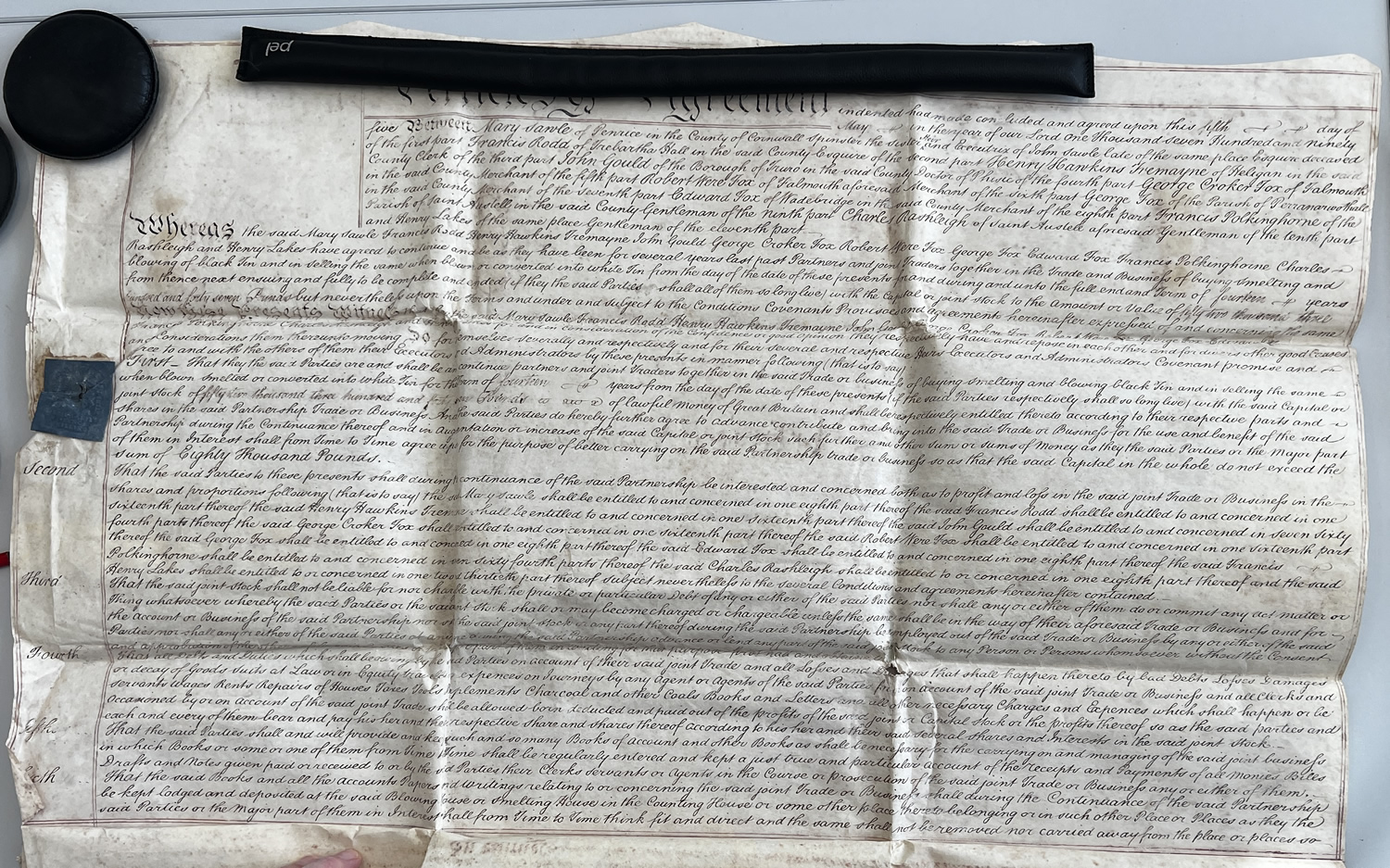
On 5 May 1795, eleven people entered into a fourteen-year agreement to
continue a joint business in the purchase, smelting and sale of tin.
The surviving manuscript is the principal artifact through which the
company’s legal form, purpose and capital can be reconstructed.
Kresen Kernow, RD/1149.
First page of the Articles of Co-Partnership, dated 5 May 1795.
Full manuscript view
Archival Identity
The record
Date
5 May 1795
Title
Articles of Co-Partnership, Joint Stock Company
Archive
Kresen Kernow
Reference
RD/1149
Parties
Mary Sawle, Francis Rodd, Henry Hawkins Tremayne, John Gould,
George Croker Fox, Robert Were Fox, George Fox, Edward Fox,
Francis Polkinghorne, Charles Rashleigh and Henry Lakes
The agreement’s principal terms
The manuscript defines the duration, capital and commercial purpose
of the company. Detailed consideration of the individual signatories
belongs in the next section.
Agreement Date
5 May 1795
The date on which the surviving articles were executed.
Duration
Fourteen years
The named term of the co-partnership agreement.
Joint Capital
£52,347
The capital recorded for the joint stock company.
Organization
Joint stock company
A shared commercial enterprise constituted through co-partnership.
Selected Clause
The business of the company
To continue as partners and joint traders in buying black tin,
smelting and blowing the same, converting it into white tin, and
selling and disposing of the white tin so produced.
Concise editorial rendering of the agreement’s stated commercial
purpose. Replace this text with the exact diplomatic transcription
if a verbatim extract is to be displayed.
Plain-Language Interpretation
The agreement did more than record a collection of investors. It
organized a substantial shared enterprise around a defined sequence
of activity: buying concentrated tin ore, transforming it
through smelting and selling the finished metal.
Its fourteen-year term gave the business an agreed period of
operation, while the stated capital of £52,347 established the
financial base from which the partners intended to trade. The use of
joint-stock language shows that capital, risk and commercial benefit
were being organized collectively rather than through a single
proprietor.
In Plain Terms
Eleven people formally committed capital to a shared tin-smelting
business. The company bought black tin, converted it into white tin
and sold the finished product through the commercial networks
available to its partners.
Signed and Sealed
The Signatories
Eleven people signed and sealed the agreement. Their residences and
social descriptions reveal a partnership extending beyond
St Austell into a wider regional network.
A register of the eleven parties
Each entry combines the identity recorded in the agreement with space
for the corresponding signature and wax seal from the manuscript.
01
Mary Sawle
Spinster
Penrice
Mary Sawle signature
Seal
Sister and executor of John Sawle, deceased, and
the representative of the Sawle interest named first in the
agreement.
02
Francis Rodd
Esquire
Trebartha Hall
Francis Rodd signature
Seal
A landed partner whose presence connected the company with
Trebartha Hall and the wider financial world of
Cornish enterprise.
03
Henry Hawkins Tremayne
Clerk
Heligan
Henry Hawkins Tremayne signature
Seal
A clergyman of Heligan whose participation illustrates how
land, family connection and investment could
overlap.
04
John Gould
Doctor of Physic
Truro
John Gould signature
Seal
A physician and investor whose description points to the
participation of professional wealth in industrial
enterprise.
05
George Croker Fox
Merchant
Falmouth
George Croker Fox signature
Seal
One of four Fox signatories, representing a major
merchant connection centred on Falmouth.
06
Robert Were Fox
Merchant
Falmouth
Robert Were Fox signature
Seal
A Falmouth merchant and part of the Fox commercial presence within
the company.
07
George Fox
Merchant
Perranarworthal
George Fox signature
Seal
A merchant based at Perranarworthal, extending the Fox presence
beyond Falmouth itself.
08
Edward Fox
Merchant
Wadebridge
Edward Fox signature
Seal
A merchant at Wadebridge whose residence demonstrates the
partnership’s reach into north Cornwall.
09
Francis Polkinghorne
Gentleman
St Austell
Francis Polkinghorne signature
Seal
A St Austell gentleman whose later-known administrative
connection to the Rashleighs may help explain his place in the
network.
10
Charles Rashleigh
Gentleman
St Austell
Charles Rashleigh signature
Seal
A St Austell partner already documented in the earlier
smelting enterprise of 1781.
11
Henry Lakes
Gentleman
St Austell
Henry Lakes signature
Seal
A St Austell partner who, with Charles Rashleigh, had acted for
the Old Blowing House partners in 1781.
Geographic Context
A partnership across Cornwall
The recorded residences link the smelting business at
St Austell with estates, professional centres and merchant
communities across the county.
PenriceMary Sawle
St Austell
Polkinghorne, Rashleigh and Lakes
Heligan
Henry Hawkins Tremayne
TruroJohn Gould
Falmouth
George Croker Fox and Robert Were Fox
PerranarworthalGeorge Fox
WadebridgeEdward Fox
Trebartha HallFrancis Rodd
What the register reveals
The agreement brought together merchants, landed figures, a
clergyman, a physician and local gentlemen. Their signatures and
seals make the partnership visible as a collective act, while their
residences show that the business depended on a network reaching far
beyond the smelting site itself. The next section turns from
who signed to the forms of capital, commerce and
influence they brought into the company.
Investment and Association
Capital, Commerce and Influence
The agreement recorded more than a shared industrial undertaking. It
brought together capital, mercantile experience, landed influence,
professional standing and local administrative knowledge within a
single enterprise.
£52,347
Recorded capital
11
Signatories
14 years
Term of agreement
Ownership
The distribution of shares
The agreement divided the company among its partners in stated
fractions. The ladder below is intended to show their relative
interests without repeating names across separate diagrams.
Mary Sawle
Insert fraction
Francis Rodd
Insert fraction
Henry Hawkins Tremayne
Insert fraction
John Gould
Insert fraction
George Croker Fox
Insert fraction
Robert Were Fox
Insert fraction
George Fox
Insert fraction
Edward Fox
Insert fraction
Francis Polkinghorne
Insert fraction
Charles Rashleigh
Insert fraction
Henry Lakes
Insert fraction
Social Composition
How the partners were described
The wording of the agreement should be read separately from the
functions later research may suggest. A legal social description
does not necessarily explain the work a person performed within the
enterprise.
Partner or group
Description in the agreement
Interpretive context
Mary Sawle
Spinster; sister and executor of John Sawle, deceased
Estate interest
Executorship
She represented the inherited Sawle interest. Her formal
description records marital status, while the executorship
identifies the legal capacity in which she entered the
agreement.
Francis Rodd
Esquire
Landed interest
Finance
His residence at Trebartha Hall and the title “esquire”
indicate landed social standing. Later research may place him
within a broader financial and commercial network.
The Fox partners
Merchants
Commerce
Merchant network
George Croker Fox, Robert Were Fox, George Fox and Edward Fox
were all expressly described as merchants. The agreement does
not individually define their operational responsibilities.
John Gould
Doctor of physic
Physician
Professional capital
His participation shows that industrial investment was not
limited to merchants and landowners. Later research also
connects him with financial networks, including the Miners
Bank.
Henry Hawkins Tremayne
Clerk
Clergyman
Estate connection
In this context, “clerk” identifies a clergyman rather than a
commercial office clerk. His residence at Heligan also places
him within an established landed family setting.
Francis Polkinghorne, Charles Rashleigh and Henry Lakes
Gentlemen
Local gentlemen
Administration
Industrial continuity
“Gentleman” was a social designation, not a precise job
description. Separate evidence connects Rashleigh and Lakes
with the 1781 smelting operation, while Polkinghorne may have
served an administrative role within the Rashleigh network.
Reading the partnership
The company’s strength did not come from capital alone. Its partners
connected the enterprise with estates, merchant houses,
professional circles, local administration and established
industrial experience.
The legal descriptions recorded in 1795 show how the parties were
formally identified. They should not automatically be treated as
complete descriptions of their business functions. Those functions
must be reconstructed from the agreement together with estate
records, banking evidence, correspondence and other surviving
sources.
From composition to connection
Considered individually, the partners represented different forms of
wealth and standing. Considered together, they formed a network of
family, business, finance, property and administration. The next
section maps those relationships and examines how the partnership
was held together beyond the terms of the agreement itself.
Relationships Behind the Agreement
The Partnership Network
The eleven signatories did not meet only at the signing table.
Family relationships, estates, banking, professional service and
earlier industrial activity connected many of them before and beyond
the fourteen-year life of the company.
Chronological Relationship Map
One enterprise, several overlapping networks
The map places the 1795 company at its centre while retaining the
earlier relationships and institutions that help explain how the
partnership came together.
Direct family relationship
Business or financial relationship
Professional, estate or land relationship
Hypothesis or relationship under study
Context and antecedents
Core partnership · 1795
Family · business · estate · research
Joint Stock Company
Sawle, Fox & Co.
1795–1809
Penrice Estate
Landed and inherited interest
Miners Bank
Financial institution
Old Blowing House
Documented by 1781
Rashleigh Office
Legal and clerical administration
Mining Interests
Specific connections under study
John Sawle
Brother of Mary · deceased by 1795
Francis Sawle
Sawle family connection
Grace Carew
Wife of Francis Sawle
Jane Carew
Mother of Charles Rashleigh
Mary Sawle
Penrice · inherited Sawle interest
Francis Rodd
Trebartha Hall · finance
Henry Hawkins Tremayne
Heligan · clergyman
John Gould
Truro · physician and finance
George Croker Fox
Falmouth · merchant
Robert Were Fox
Falmouth · merchant
George Fox
Perranarworthal · merchant
Edward Fox
Wadebridge · merchant
Francis Polkinghorne
Professional service to Rashleighs
Charles Rashleigh
St Austell · 1781 continuity
Henry Lakes
St Austell · 1781 continuity
Core Partnership
Sawle, Fox & Co.
1795–1809 · Eleven signatories
Mary Sawle
Family
Estate
Partnership
Sister of John Sawle; inherited the Sawle interest at Penrice;
connected through the wider Sawle–Carew–Rashleigh kinship
network; signatory to the 1795 partnership.
Francis Rodd and John Gould
Finance
Banking
Both belong to the financial context surrounding the Miners Bank.
Their precise responsibilities within the smelting company should
remain distinct from their external financial associations.
Charles Rashleigh and Henry Lakes
Business
Industrial continuity
Both were already documented acting for the Old Blowing House
partners in the 1781 lease.
Francis Polkinghorne
Professional
Documented within the Rashleigh administrative or clerical
network. This professional relationship should not be presented
as evidence of kinship.
The Fox merchants
Commerce
Partnership
George Croker Fox, Robert Were Fox, George Fox and Edward Fox
connected the company with merchant communities at Falmouth,
Perranarworthal and Wadebridge.
Henry Hawkins Tremayne
Estate
Clergyman
His recorded residence at Heligan places him within a landed and
clerical context, although the agreement does not define a
separate operational role.
01
Mary Sawle at the centre
Mary appears here as an inheritor, landholder, family connection and
commercial participant. Her later role as executor is important, but
it is not the sole explanation for her place beside Charles
Rashleigh. The wider Sawle–Carew–Rashleigh kinship
existed independently of the 1795 agreement.
02
Industry before incorporation
The Old Blowing House links John Sawle, Henry Lakes and Charles
Rashleigh to a partnered smelting operation documented in 1781.
This is evidence of continuity in people, land and activity, but not
proof that the earlier enterprise was legally identical to the
company formed in 1795.
03
Service is not kinship
Francis Polkinghorne’s connection to the Rashleighs is presented as
a professional and administrative relationship.
It should not be converted into a family relationship unless
separate genealogical evidence establishes one.
Beyond 1809
The formal partnership had a defined fourteen-year term, but the
relationships surrounding it did not end with the agreement.
Property, professional association and family connection continued
into another generation. The next section follows those connections
beyond the original signatories and toward the marriages that would
eventually bring the Lakes, Gould and Lemon families together.
From Enterprise to Inheritance
After the Partnership:
The Next Generation
The named term of the partnership ended in 1809, but the families,
professions and commercial circles surrounding it continued. In the
next generation, the Lakes and Gould families became connected by
marriage, followed in 1829 by a further union with Samuel Buller
Lemon.
Chronological Transition
From the blowing house to the Lemon marriage
Four dates trace the movement from the documented origins of the
smelting operation through the formal partnership and into the
family relationships of the next generation.
1781
Smelting house under construction at Blowing House Hill.
1795
Fourteen-year co-partnership agreement signed and sealed.
1809
The named fourteen-year term reaches its conclusion.
1829
Rachel Lakes marries Samuel Buller Lemon.
Family Continuation
The Lakes, Gould and Lemon connection
The central line records parentage and marriage. Contextual
relationships sit outside it and are shown separately so that
professional, collateral and commercial associations are not
mistaken for direct descent.
Direct family sequence
Contextual relationships
Henry Lakes
Partner in 1795 · St Austell
John Gould
Partner in 1795 · Truro physician
William Henry Lakes
Son of Henry Lakes
Rachel Gould
Daughter of John Gould
Rachel Lakes
Daughter of William Henry Lakes and Rachel Gould
Samuel Buller Lemon
Married Rachel Lakes in 1829
Charles Rashleigh
Professional context for William Henry Lakes
Edward Coode
Connected through Dorothy Robins Lakes
William Lemon
Prominent Lemon line · collateral relationship
Lemon and Daniell Mining Context
Later ownership, sett and smelting questions
Partnership generation
Henry Lakes and John Gould
Both men were signatories to the 1795 agreement. Henry Lakes was
the father of William Henry Lakes. John Gould was the father of
Rachel Gould.
Marriage of the next generation
William Henry Lakes married Rachel Gould
Their marriage joined the children of two members of the earlier
partnership.
Their daughter
Rachel Lakes
Rachel Lakes was the daughter of William Henry Lakes and Rachel
Gould.
1829
Rachel Lakes married Samuel Buller Lemon
This marriage carried the family sequence from the Lakes and Gould
households into the Lemon family.
Wider context
Charles Rashleigh belongs to the professional
context surrounding the clerkship or service of William Henry
Lakes.
Edward Coode enters the wider Lakes network
through Dorothy Robins Lakes, rather than through the direct
descent shown above.
William Lemon represents the prominent Lemon
family line to which Samuel Buller Lemon was collaterally
related.
The Lemon and Daniell mining context raises
later questions about mining ownership, sett rights and where
associated ore may have been smelted.
Parent and child
Marriage
Professional relationship
Collateral or commercial context
Interpretive Question
Did the commercial and professional world of one generation help shape
the social and marital possibilities of the next?
01
A documented sequence
The parent-child relationships, the marriage of William Henry Lakes
and Rachel Gould, and the 1829 marriage of Rachel Lakes and Samuel
Buller Lemon establish a clear chronological and
generational sequence.
02
A continuing social world
The children of two original partners later married one another.
Professional service, estate administration and commercial
association may help explain the social environment in which these
families remained connected.
03
Not proof of causation
Closeness, sequence and shared networks do not demonstrate that the
1795 partnership directly caused a later marriage. That stronger
conclusion would require correspondence, diaries, legal papers or
other direct evidence.
From industrial history to family history
What began as an investigation into a Cornish smelting partnership
now reaches a recognizable family line. The records of land,
enterprise, profession and marriage do not tell a single inevitable
story, but together they show how industrial history and
family history intersect. The next section explains how
this partnership entered the history of the Lemon family and why it
matters to the wider research.
From Partnership to Family History
From Industrial Record
to Family History
The partnership agreement first appeared to be a record of Cornish
industry. It became something more personal when the names within it
began to connect to the family line I was already tracing.
Henry Lakes first drew my attention because he belonged to the Lakes
family through which my Lemon research passed. His appearance in the
1795 agreement placed that family inside a substantial tin-smelting
enterprise, alongside merchants, landowners, professionals and men
already active in the industrial life of Cornwall.
The agreement then revealed a second connection. Another partner,
John Gould, was the father of Rachel Gould. She
married Henry Lakes’s son, William Henry Lakes,
joining the children of two members of the earlier partnership.
What had first looked like a list of unrelated investors began to
resemble a continuing social and professional circle.
Their daughter, Rachel Lakes, carried that connection
into another family when she married Samuel Buller
Lemon in 1829. Samuel belonged to a collateral branch of the
wider Lemon family, linking the Lakes and Gould sequence to the
family history that had led me to these records.
The Personal Significance
The document does not merely identify what these people owned or
how they traded. It places my ancestral family within the
industrial, professional and social world of late
eighteenth-century Cornwall.
The agreement matters because it adds context that a pedigree alone
cannot provide. It shows the scale of the enterprise, the places in
which the partners operated, the people with whom they were
associated and the networks that remained visible in the following
generation.
It cannot prove that the partnership caused the later marriages.
What it can demonstrate is that the families were not moving through
isolated lives. They occupied overlapping worlds of commerce,
estate management, professional service, kinship and place.
The Line into the Lemon Family
From two partners to a later family connection
This strip shows the essential generational movement only. It is not
intended as a complete family tree.
Henry Lakes
and John Gould
Partners in 1795
William Henry Lakes
and Rachel Gould
Children of the partnership generation
Rachel Lakes
Their daughter
Samuel Buller Lemon
Married Rachel Lakes · 1829
The sequence establishes relationship and chronology. It does not, by
itself, establish that the commercial partnership arranged or caused
the marriages that followed.
Conclusion
In this one record, enterprise is anchored to place, place reveals a
network, and that network carries consequences into the next
generation—and ultimately into my own family history.
Records, Evidence and Further Research
Sources and
Open Questions
This exhibit is grounded in two principal archival records and
supported by genealogical, estate, banking and industrial evidence.
The surviving material establishes a substantial foundation, while
leaving important questions about the company’s operation, ownership
and later history unresolved.
Part A
Principal records
The first record establishes partnered smelting activity in 1781.
The second defines the formally documented co-partnership of 1795.
Principal Record 01
CF/1/301
Lease at Blowing House Hill · 17 July 1781
Lease involving John Sawle and Henry Lakes and Charles Rashleigh
acting on behalf of their partners. It records a smelting house
under construction, associated water rights and a term of fifty
years. Preserved at Kresen Kernow.
Principal Record 02
RD/1149
Articles of Co-Partnership · 5 May 1795
Fourteen-year agreement between eleven named parties for buying
black tin, smelting and blowing it, converting it into white tin
and selling the finished product. It records capital of £52,347.
Preserved at Kresen Kernow.
Supporting records and research
Parish registers and civil records used to
reconstruct births, marriages, deaths and parent-child
relationships among the Lakes, Gould and Lemon families.
Probate and estate material relating to the
Sawle, Rashleigh, Lakes, Gould and connected families.
Banking and commercial records concerning John
Gould, Francis Rodd, the Miners Bank and associated financial
relationships.
Property, lease and mining records relating to
Blowing House Hill, mining interests, sett rights and the wider
Cornish mineral economy.
Family histories and pedigrees used as research
guides and tested against contemporary records wherever possible.
Historical studies of Cornish tin used to explain
smelting, black tin, white tin, commerce and the regional
industrial setting.
Part B
Evidence key
Four concise categories distinguish what the records state from what
has been reconstructed, interpreted or left unresolved.
Documented evidence
Information stated directly in a surviving contemporary record,
manuscript, register, deed or agreement.
Genealogical reconstruction
A family relationship assembled from multiple records rather than
stated in a single surviving source.
Historical interpretation
A reasoned explanation of what the evidence may reveal about
industry, society, place or relationships.
Open question
A point not yet resolved by the available evidence and requiring
further archival research.
Part C
Open questions
These questions define the next stage of research and identify where
further archival evidence could materially change the interpretation
of the partnership.
What was the legal and operational relationship between the 1781 and
1795 partnerships?
What happened when the fourteen-year term reached 1809?
Where did the partnership acquire its black tin?
To whom did it sell white tin?
Did it process ore associated with the Daniell or Lemon mining
interests?
What roles did individual signatories perform?
How were the Fox partners related?
Why do the recorded shares require reconciliation?
What additional evidence clarifies Francis Polkinghorne’s role?