
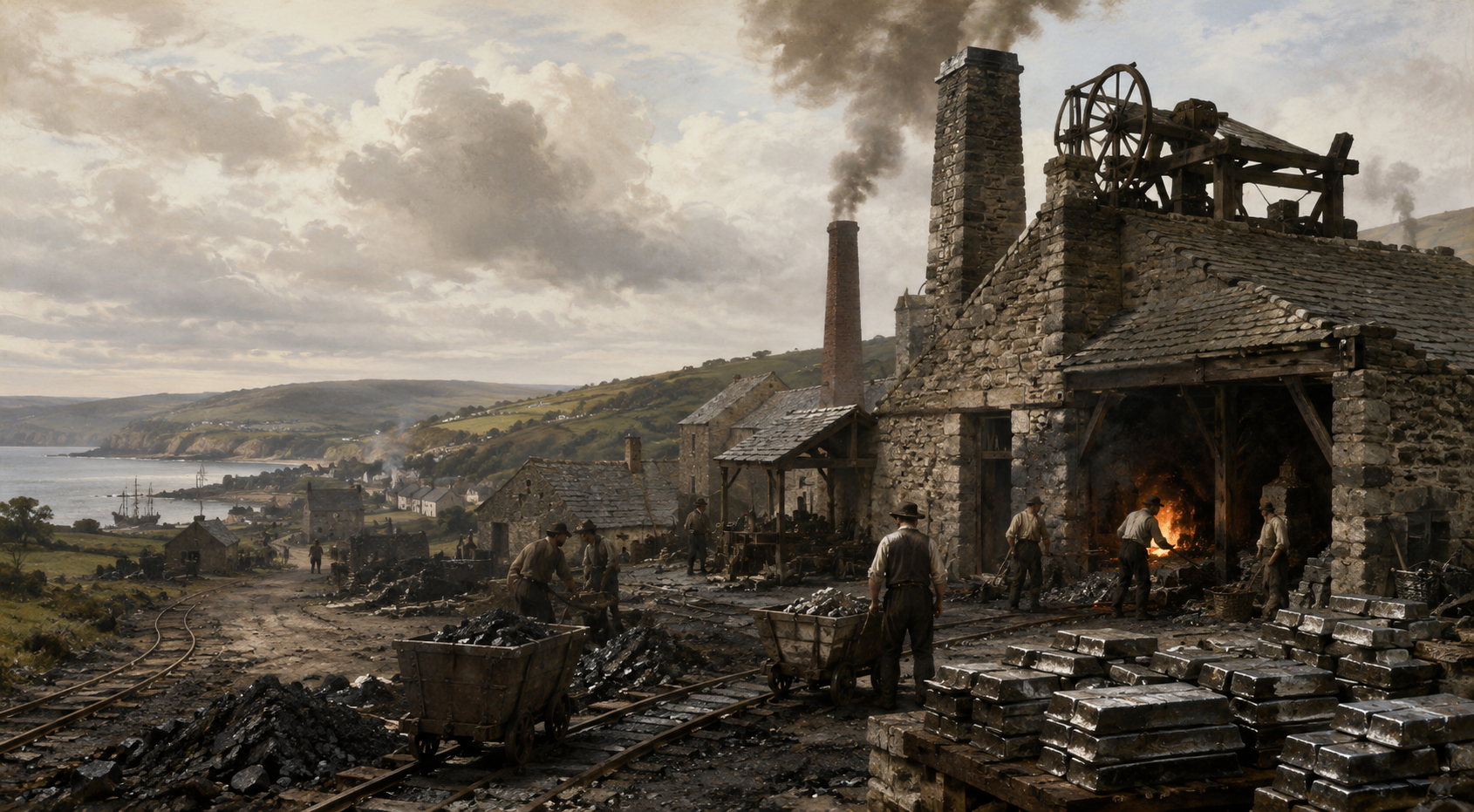
Family History Exhibit
Sawle, Fox & Co.
Tin, capital and kinship in industrial Cornwall
In 1795, eleven partners committed more than £52,000 to the business of buying black tin, refining it through blowing and smelting, and selling the finished white tin. Their partnership brought together some of Cornwall’s most influential landed, professional, mercantile and industrial families.
- St Austell, Cornwall
- 11 Partners
- £52,340 Joint Capital
- 1795 Partnership
Based on the Articles of Co-Partnership dated 5 May 1795.
Kresen Kernow, FOX/B/4/12.
The story behind the partnership
Sawle, Fox & Co. was more than a tin-smelting enterprise. Its partners were connected through marriage, kinship, law, land, estate administration and shared investment. This exhibit explores both the industrial company and the network of people who stood behind it.
Exhibit Introduction
More than a tin-smelting partnership
Sawle, Fox & Co. was an industrial enterprise built from capital, professional relationships and a closely connected network of Cornish families.
In May 1795, eleven Cornish investors entered into a formal partnership to purchase black tin, smelt it and bring the finished white tin to market.
Their agreement created Sawle, Fox & Co., a business supported by £52,340 in joint capital and connected to some of Cornwall’s most influential mercantile, professional and landed families.
At first glance, the partnership appears to be a story of furnaces, investment and industrial enterprise. The surviving agreement, however, reveals something more intricate. Its shareholders were linked through marriage, inheritance, professional training, friendship and family obligation.
Among them was Henry Lakes, whose place in the partnership connects this industrial venture to the Gould, Rashleigh, Tremayne, Sawle and Lemon families. His involvement provides an unusually clear view of how kinship and commerce could operate together in late eighteenth-century Cornwall.
This exhibit examines the partnership as both a commercial organization and a social network: who invested, how they were connected, and what the agreement can tell us about wealth, trust and opportunity in industrial Cornwall.
Reading Guide
How to read this exhibit
The surviving partnership agreement records shares, capital and legal obligations. This exhibit reads beyond those formal terms to examine the industrial process, the people involved and the family networks behind the business.
Industrial Context
Follow the industrial process
Begin with the transformation of black tin into white tin. This provides the practical context for understanding what the partnership purchased, produced and sold.
Primary Evidence
Read the agreement as evidence
The 1795 articles reveal the formal structure of the company: its partners, joint capital, ownership shares and the rules that governed their commercial relationship.
Social Network
Look beyond the shareholder list
The partners were not isolated investors. Marriage, inheritance, legal training, professional association and family obligation connected many of them before they entered the partnership.
Historical Method
Distinguish evidence from interpretation
The exhibit separates what the records directly document from relationships reconstructed through wills, marriage settlements, apprenticeship records, family pedigrees and other archival sources.
Genealogical Thread
Return to Henry Lakes
Henry Lakes provides the genealogical thread through the exhibit. His investment connects the company to the Gould, Rashleigh and Lemon families and to the later history of his descendants.
People and Biographies
Explore the partners individually
The partner register introduces each shareholder and will link to individual biography pages as the wider family-history collection develops.
Industrial Process
From black tin to white tin
Sawle, Fox & Co. entered the tin trade at the point where mined and dressed ore became a saleable metal. The partnership purchased black tin, smelted it and brought the resulting white tin to market.
In eighteenth-century Cornwall, “black tin” did not refer to finished metal. It was the concentrated tin ore produced after mined material had been crushed, washed and separated from much of the surrounding rock.
Smelters purchased this prepared ore and subjected it to intense heat in order to separate the tin from the remaining mineral matter. The metal produced through that process was known as “white tin.”
The distinction is central to understanding the partnership agreement. Sawle, Fox & Co. was not primarily a mining company. Its business lay in purchasing the product of the mines, converting it into metal and organizing its movement into the wider market.
Mining and Dressing
Ore was raised, crushed and washed
Tin-bearing rock was extracted from the mine and broken into smaller pieces. It was then stamped, washed and separated so that the heavier tin ore could be concentrated and much of the waste material removed.
The result was black tin: a prepared mineral concentrate ready for sale to a smelter.
Purchase and Assay
Smelters purchased the concentrated ore
The value of black tin depended on its quality and expected metal content. Smelting firms relied on weighing, sampling and assay to judge what they were buying and to determine the price paid to the mine or adventurers.
At this stage, commercial judgement mattered as much as furnace capacity.
Smelting
Heat separated the metal from the ore
The black tin was mixed with fuel and other materials before being charged into the furnace. Under intense heat, the tin oxide was reduced and molten tin separated from the remaining slag and impurities.
The furnace transformed a mineral commodity into liquid metal.
Refining and Casting
The molten tin was cleaned and cast
The metal could be further refined before being poured into moulds. Once cooled, the resulting blocks or ingots were easier to inspect, transport and sell.
This finished metallic product was known as white tin.
Sale and Distribution
White tin entered the market
Once produced and certified for sale, the metal could move through merchants, ports and manufacturers. The partnership therefore sat between Cornwall’s mining economy and the wider commercial world that consumed Cornish tin.
Profit depended on purchasing well, smelting efficiently and selling into a larger trading network.
Primary Record
The 1795 archival agreement
The Articles of Co-Partnership dated 5 May 1795 provide the documentary foundation for this exhibit. They identify the partners, define the business and record the capital committed to the venture.
Preserved at Kresen Kernow under the reference FOX/B/4/12, the agreement formalized the relationship between eleven shareholders entering the Cornish tin-smelting trade.
Its language is commercial and legal. The partners agreed to combine capital for the buying of black tin, its blowing and smelting, and its conversion into white tin. They also established the terms under which the enterprise would operate and the proportions in which each shareholder participated.
The document matters because it fixes the partnership at a particular moment. It does not merely preserve the name of the firm; it records who stood behind it, how much capital they controlled and the legal framework through which they intended to act together.
Read alongside wills, marriage connections, professional records and family pedigrees, the agreement becomes more than a business record. It provides an entry point into the social relationships that helped sustain the enterprise.
Reading the Record
What the agreement tells us
The document establishes several layers of evidence that shape the rest of the exhibit.
Commercial Purpose
It defines the business
The partners were to purchase black tin, blow and smelt it, and convert it into white tin. This places the firm within the processing and commercial stages of Cornwall’s tin economy.
Membership
It names the shareholders
Eleven individuals entered the partnership. Their inclusion provides the starting point for reconstructing the company’s ownership and the relationships between its members.
Financial Scale
It records substantial joint capital
The partnership began with £52,340 in joint stock and contained authority to increase the capital to as much as £80,000. The scale of the commitment indicates a significant industrial and commercial undertaking.
Ownership
It divides the enterprise into shares
The partners did not participate equally. Their fractional interests reveal differences in financial exposure, influence and expected return.
Legal Structure
It formalizes trust through contract
Family and professional relationships may have helped bring the partners together, but the agreement translated that trust into legal obligations, shared rules and enforceable financial terms.
How to Read the Agreement
A legal record with social evidence beneath it
The document directly proves that the named individuals entered the partnership and held specified financial interests. It also records the stated purpose and capital structure of the enterprise.
It does not, by itself, explain why these particular people chose to invest together. That interpretation emerges only when the agreement is placed beside evidence of marriages, inheritances, professional training and longstanding family connections.
Financial Structure
Capital and ownership
The partnership combined substantial joint capital with unequal ownership interests. The recorded fractions show who carried the greatest financial stake and how participation was distributed across the eleven partners.
Sawle, Fox & Co. began with £52,340 in joint stock, with authority under the agreement to increase the capital of the enterprise to as much as £80,000.
This capital supported more than the physical operation of a smelting works. It allowed the partnership to purchase black tin, absorb the costs and risks of processing it, pay labour and operating expenses, and wait for the finished white tin to be sold.
The shareholders did not participate equally. Their fractional interests ranged from one-sixteenth to ten-sixty-fourths, suggesting different levels of investment, exposure and influence within the partnership.
Recorded Interests
The ownership structure
The bars below compare the recorded interests by size. They show the relative weight of each holding without converting the fractions into percentages while the surviving figures remain under review.
Largest recorded interest
Henry Lakes
10/64
George Fox
1/8 — 8/64
Edward Fox
1/8 — 8/64
Charles Rashleigh
1/8 — 8/64
John Gould
7/64
Francis Polkinghorne
7/64
Francis Rodd
1/16 — 4/64
Henry Hawkins Tremayne
1/16 — 4/64
George Croker Fox
1/16 — 4/64
Robert Were Fox
1/16 — 4/64
Only female partner
Mary Sawle
1/16 — 4/64
Reading the Distribution
Unequal shares, shared enterprise
Henry Lakes held the largest individual interest currently recorded, at ten-sixty-fourths. George Fox, Edward Fox and Charles Rashleigh each held one-eighth, while John Gould and Francis Polkinghorne each held seven-sixty-fourths.
The remaining partners held one-sixteenth interests. This included Mary Sawle, the only woman named as a partner and the sister, heir and executrix of John Sawle.
Ownership therefore formed a tiered structure rather than an equal association. The distribution invites further questions about who supplied capital, who exercised operational influence and whether some interests reflected inherited or family wealth.
Partnership Register
The partners behind the enterprise
Eleven people were named in the 1795 agreement. Read together, they form more than a list of investors: they reveal a network of families, inherited interests, professional associations and overlapping commercial relationships.
This register provides an entry point into the lives of the individual partners. Each name links to a dedicated person page where surviving records, family connections and involvement in the partnership can be examined in greater depth.
The partners are arranged by the size of their recorded interest, beginning with Henry Lakes, whose ten-sixty-fourths formed the largest individual holding presently identified in the agreement.
The register preserves the fractional interests as they appear in the current transcription. These figures should be read alongside the research caution noted in the preceding section.
Named in the Agreement
Eleven partners
Recorded interests are shown exactly as currently transcribed. The brief notes identify why each person matters within the wider story of Sawle, Fox & Co.
Largest recorded interest
Henry Lakes
Holder of ten-sixty-fourths and the principal ancestral connection through which this partnership enters the Lakes, Gould, Rashleigh and Lemon family story.
One-eighth interest
George Fox
One of four partners bearing the Fox name and one of three shareholders recorded with an interest of one-eighth.
One-eighth interest
Edward Fox
A substantial shareholder within the Fox group of partners, holding the same recorded interest as George Fox and Charles Rashleigh.
One-eighth interest
Charles Rashleigh
A major shareholder whose marriage to Grace Tremayne connected the Rashleigh and Tremayne families. He later acted as executor of Mary Sawle’s estate.
Seven-sixty-fourths interest
John Gould
Father of Rachel Gould, whose later marriage to William Henry Lakes carried the Gould and Rashleigh connections into the next generation of the Lakes family.
Seven-sixty-fourths interest
Francis Polkinghorne
Holder of the same recorded interest as John Gould and one of the larger shareholders outside the one-eighth group.
One-sixteenth interest
Francis Rodd
One of five partners recorded with an interest of one-sixteenth in the joint enterprise.
One-sixteenth interest
Henry Hawkins Tremayne
Brother of Grace Tremayne, the wife of fellow partner Charles Rashleigh, making the partnership connection both commercial and familial.
One-sixteenth interest
George Croker Fox
One of the four Fox-named partners and a holder of a one-sixteenth interest in the company.
One-sixteenth interest
Robert Were Fox
A Fox-named shareholder whose presence adds to the visible concentration of related commercial interests within the partnership.
Only female partner
Mary Sawle
Described in the agreement as a spinster and as the sister, heir and executrix of John Sawle. Her participation shows how an inherited interest could place a woman within a substantial eighteenth-century industrial partnership.
Reading Across the Names
A register becomes a network
Considered separately, the eleven entries identify the people who supplied capital to the enterprise. Considered together, they reveal recurring surnames, marriages, inheritances and relationships that extended beyond the smelting works.
The register is therefore not merely a navigation device. It is the first visible layer of the partnership’s social structure: a group of individuals whose commercial participation was reinforced by family connection, professional trust and shared local interests.
Partnership Network
How the partners were connected
The partnership was held together by more than invested capital. Marriage, sibling relationships, inheritance, cousinship and professional association joined several of the partners within a wider Cornish network of family and trust.
Sawle, Fox & Co. can be read as a commercial agreement, but the names within it also form a social map. Some partners were related directly. Others were connected through spouses, siblings, inherited interests or relationships that continued into the next generation.
These connections help explain how a group of eleven people could enter a substantial industrial undertaking together. In an eighteenth-century partnership, confidence in another person’s family, reputation and financial reliability could be as important as the written terms of the agreement.
The sequence below distinguishes relationships supported by named family connections from broader patterns that remain interpretive or require further research.
Relationship Pathways
A partnership built through overlapping ties
The network is presented as a sequence of relationship pathways. Each pathway identifies the people involved, the type of connection and why that relationship matters to the history of the partnership.
Documented family relationship
Rashleigh and Tremayne
Marriage and sibling connection
Charles Rashleigh’s marriage to Grace Tremayne made fellow partner Henry Hawkins Tremayne his brother-in-law. Their presence in the same partnership therefore joined two households through both commerce and marriage.
This is one of the clearest direct examples of family connection within the 1795 shareholder group.
Documented family relationship
Rashleigh and Gould
Sibling and marriage connection
John Gould was married to Rachel Rashleigh, the sister of Charles Rashleigh. The two partners were therefore brothers-in-law, linking the Gould and Rashleigh interests within the company.
Their connection would later become especially important to the Lakes family through John and Rachel Gould’s daughter.
Next-generation continuation
Gould and Lakes
Descent and marriage
Rachel Gould, daughter of John Gould and Rachel Rashleigh, married William Henry Lakes, the son of fellow partner Henry Lakes.
This marriage joined the Gould, Rashleigh and Lakes families in the generation following the partnership. It transformed a commercial association between the fathers into a direct family connection between their descendants.
Family and estate connection
Rashleigh and Sawle
Cousinship and executorship
Mary Sawle belonged to a wider Sawle, Carew and Rashleigh cousin network. Her connection with Charles Rashleigh did not end with their shared participation in the company.
When Mary died, Charles acted as an executor of her estate. That responsibility indicates a relationship of continuing family confidence and legal trust beyond the partnership itself.
Professional continuation
Lakes and Rashleigh
Legal training and patronage
On 21 October 1788, William Henry Lakes was articled under Charles Rashleigh. This professional relationship preceded the 1795 partnership and connected the Lakes household to Rashleigh through legal training and patronage.
It shows that the association between Henry Lakes and Charles Rashleigh was not confined to a single commercial agreement. It also shaped the career of Henry’s son.
Relationship under further study
The Fox concentration
Shared surname and commercial interest
Four partners carried the Fox surname. Together they represented a substantial concentration of recorded ownership within the enterprise.
Their shared surname strongly suggests that family organization formed part of the company’s structure, but the exact relationships among all four men should be stated only where supported by the relevant family and partnership records.
Reading the Network
Capital moved through relationships
The agreement divided ownership into fractions, but the social network did not divide so neatly. Charles Rashleigh stood at the centre of several connections: brother-in-law to John Gould, brother-in-law to Henry Hawkins Tremayne, professionally connected to William Henry Lakes and later executor for Mary Sawle.
Henry Lakes and John Gould were linked first as partners and later through the marriage of their children. Mary Sawle entered the company through an inherited Sawle interest while remaining connected to the Rashleigh family through cousinship and estate administration.
Seen in this way, Sawle, Fox & Co. was not simply financed by eleven isolated shareholders. It drew strength from a network in which commerce, family and professional confidence repeatedly overlapped.
Family Continuation
Henry Lakes and the continuation through Gould, Rashleigh and Lemon
For this family history, the significance of Sawle, Fox & Co. does not end with the 1795 agreement. The partnership forms part of a longer sequence in which commercial relationships became family relationships and were carried into later generations.
Henry Lakes entered the partnership with the largest individual interest presently recorded. His importance to this exhibit, however, extends beyond the size of his share.
Through his son William Henry Lakes, the Lakes family became joined to the Gould and Rashleigh families already represented within the partnership. That union carried the social world surrounding Sawle, Fox & Co. into the next generation and, through later descent, into the Lemon family line.
The sequence is not simply one of surnames replacing one another. It shows how professional association, marriage, inheritance and descent could preserve relationships long after the original commercial venture had changed or disappeared.
Generational Sequence
From partner to descendant
The pathway below follows the documented relationships that connect Henry Lakes to the Gould and Rashleigh families and then places those relationships within the later Lemon family history.
The partner
Henry Lakes
Partner in 1795
Henry Lakes held ten-sixty-fourths of the partnership, the largest individual interest currently identified in the agreement. His participation places him within a substantial network of Cornish investors, landholders and professional families.
Records associated with Henry also locate him within the wider social structure of the period. A surviving deputation identifies him as a gamekeeper, while the partnership agreement records his involvement in a capital-intensive industrial enterprise.
These records reveal different parts of the same life: employment and local service on one hand, and investment and partnership on the other.
The next generation
William Henry Lakes
Son of Henry Lakes
Henry’s son, William Henry Lakes, had already entered the orbit of another future partner before the 1795 agreement was signed. On 21 October 1788, he was articled under Charles Rashleigh.
That legal apprenticeship created a professional connection between the Lakes and Rashleigh households. It suggests that the relationship between Henry Lakes and Charles Rashleigh was not confined to their joint investment in Sawle, Fox & Co.
Charles Rashleigh participated in the professional formation of Henry’s son, placing William Henry within the same network of trust, patronage and association that later appears in the partnership agreement.
Documented Connection
Articles of clerkship
William Henry Lakes was articled under Charles Rashleigh on 21 October 1788, seven years before their fathers’ generation appeared together in the partnership.
The marriage
William Henry Lakes and Rachel Gould
Lakes, Gould and Rashleigh united
Son of Henry Lakes
Daughter of John Gould and Rachel Rashleigh
Rachel Gould was the daughter of partner John Gould and his wife, Rachel Rashleigh. Her mother was the sister of Charles Rashleigh, another of the eleven partners.
Through Rachel, the Gould and Rashleigh lines were already joined. Her marriage to William Henry Lakes then brought those relationships directly into the Lakes family.
The sons and daughters of two business associates therefore created a family connection between households that had first appeared together within the same commercial network.
The inherited network
Gould and Rashleigh
Family identity carried forward
Partnership generation
Next generation
Rachel Gould carried into her marriage more than the Gould surname. Through her mother, she also descended from the Rashleigh family.
Her place within the family tree therefore preserved two of the principal relationships visible in the 1795 agreement. John Gould was her father, while Charles Rashleigh was her maternal uncle.
What had appeared in the partnership as separate shareholder interests became, in the next generation, part of one connected ancestry.
The later family line
The continuation into the Lemon family
Later descent
Through the descendants of William Henry Lakes and Rachel Gould, the Lakes, Gould and Rashleigh inheritance continued into the Lemon family.
By the time the line appears under the Lemon surname, the original partnership is no longer a current business event. It has become part of the family’s inherited social and genealogical background.
The connection demonstrates why a commercial record from 1795 belongs within a broader family history. It identifies the people, relationships and institutions surrounding an earlier generation whose descendants later formed part of the Lemon family story.
The Line of Continuation
Commerce became family history
Interpretive Significance
The partnership as an ancestral environment
Sawle, Fox & Co. was not passed intact from one generation to the next. What continued were the relationships surrounding it.
Henry Lakes’s commercial association with John Gould and Charles Rashleigh was reinforced through his son’s professional training and marriage. The Gould and Rashleigh families then became part of the ancestry inherited by later Lakes descendants and, eventually, by the Lemon family.
The agreement therefore offers a view of the social environment from which this branch of the family emerged: an environment shaped by mining, investment, law, marriage, kinship and local influence.
Sources and Research Notes
The evidence behind the exhibit
This exhibit brings together partnership records, legal documents, newspapers and genealogical evidence. The sources establish the people and relationships; the interpretation considers what those records reveal when read together.
Sawle, Fox & Co. survives not through a single complete business archive, but through records created for different legal, commercial and family purposes.
The 1795 articles of partnership provide the foundation of the exhibit. Other records help place individual partners within their families, professions and local communities.
Read collectively, these sources make it possible to reconstruct both the formal structure of the company and the network of relationships that surrounded it.
How to Read the Research
Four levels of historical confidence
Documented evidence
Information stated directly in an archival, legal, newspaper or genealogical record.
Genealogical reconstruction
Family relationships established by comparing multiple records across generations.
Historical interpretation
An explanation of what the documented relationships may reveal about commerce, kinship, patronage and social networks.
Open research question
A discrepancy, incomplete citation or relationship that requires further evidence before a firm conclusion can be reached.
Source Register
Principal records used
The entries below identify the principal records currently supporting the exhibit. Additional citations can be added as the wider family and business research develops.
Partnership Record
Articles of Co-Partnership for Sawle, Fox & Co.
- Date
- 5 May 1795
- Repository
- Kresen Kernow
- Reference
- FOX/B/4/12
Used in this exhibit to establish
- The name and commercial purpose of the partnership
- The eleven recorded shareholders
- The initial joint capital of £52,340
- The authority to increase capital to £80,000
- The recorded fractional interests of the partners
Quarter Sessions Record
Deputation of Henry Lakes as gamekeeper
- Repository
- Kresen Kernow
- Reference
- QS/1/4/502
- Record type
- Gamekeeper deputation
Used in this exhibit to establish
- An additional documented role held by Henry Lakes
- His place within the local administrative and landed world
- The contrast between occupational office and industrial investment
Legal Training Record
Articles of clerkship for William Henry Lakes
- Date
- 21 October 1788
- Parties
- William Henry Lakes and Charles Rashleigh
- Reference
- [Complete archival citation]
Used in this exhibit to establish
- The professional connection between William Henry Lakes and Charles Rashleigh
- A Lakes–Rashleigh relationship predating the 1795 partnership
- Charles Rashleigh’s role in the training of Henry Lakes’s son
Newspaper
Death notice for Henry Lakes
- Publication
- Royal Cornwall Gazette
- Date
- 17 January 1835
- Record type
- Death notice
Used in the wider research to establish
- The later life and death of Henry Lakes
- A chronological boundary for his biography
- Contemporary public reporting of his death
Probate and Estate Records
Records relating to Mary Sawle and her estate
- Person
- Mary Sawle
- Relevant capacity
- Heir and executrix of John Sawle
- Additional connection
- Charles Rashleigh acted as executor
Used in this exhibit to support
- Mary Sawle’s legal and familial identity
- Her connection to John Sawle’s estate
- The continuing relationship between Mary Sawle and Charles Rashleigh
- Her place within the wider Sawle, Carew and Rashleigh network
Genealogical Evidence
Parish, probate and family relationship records
- Record groups
- Marriage, baptism, burial and probate records
- Geographic focus
- Cornwall and connected family locations
- Citation status
- To be expanded in individual people pages
Used to reconstruct
- The marriage of John Gould and Rachel Rashleigh
- Rachel Rashleigh’s relationship to Charles Rashleigh
- The marriage of William Henry Lakes and Rachel Gould
- The continuation of the line into the Lemon family
Research Notes
Questions, cautions and work still in progress
These notes preserve uncertainties encountered during the research. They are included so that interpretation does not appear more certain than the surviving evidence allows.
Numerical discrepancy
The recorded shares total more than the whole
The fractional interests currently transcribed from the partnership material total 68/64 rather than 64/64.
This may reflect a transcription error, a misunderstanding of one or more entries, an amendment within the original agreement, or a structure not yet fully understood.
Next research step: Re-examine the original document and compare every fraction against the archival image or manuscript.
Relationship under study
The precise relationships among the Fox partners
George Fox, Edward Fox, George Croker Fox and Robert Were Fox formed a substantial concentration within the partnership.
Their shared surname and collective commercial presence are significant, but the exhibit does not assign exact relationships until those connections have been supported by genealogical evidence.
Next research step: Reconstruct the relevant Fox family branches using parish, probate and family papers.
Citation development
Complete the clerkship reference
The date and parties to William Henry Lakes’s clerkship under Charles Rashleigh have been identified, but the complete archival citation should be added before the exhibit is treated as fully referenced.
Next research step: Record the repository, collection, document reference and image or folio details.
Genealogical expansion
Trace the Lemon continuation generation by generation
The present exhibit identifies the continuation from Henry Lakes through William Henry Lakes and Rachel Gould into the later Lemon family.
A dedicated genealogical note should eventually identify every intervening generation and cite the evidence connecting each parent to child.
Next research step: Add a fully cited lineage pathway to the Lemon family page.
Historical context
Separate period terminology from modern explanation
The terms black tin and white tin belong to the historic process described by the partnership records.
Explanatory language used elsewhere in the exhibit is intended to make that process understandable to a modern reader. It should not be mistaken for wording quoted directly from the 1795 agreement.
Editorial principle: Preserve a visible distinction between language found in the record and language added for interpretation.
Interpretive caution
Kinship does not by itself prove commercial motive
The partnership included several people connected through marriage, descent, professional training or estate administration.
These relationships demonstrate that the partners operated within an interconnected social world. They do not, without further evidence, prove that any individual was admitted solely because of family influence.
Interpretive limit: The exhibit identifies the network without assigning motives that the surviving records do not state.
Citation Practice
How references will be recorded
Archival references should identify the repository, collection, document title or description, date and catalogue reference.
Newspaper references should include the publication title, date, page where known and the database or archive through which the image was consulted.
Genealogical assertions should be supported at the individual-person level, allowing each relationship shown in the exhibit to be traced back to the underlying record.
Closing the Exhibit
A partnership reconstructed through fragments
The surviving records do not provide a complete narrative of Sawle, Fox & Co. They preserve selected moments: an agreement, a legal apprenticeship, an estate relationship, a family marriage and a newspaper notice.
Together, those fragments reveal more than the existence of a tin-smelting company. They show how industrial enterprise was situated within families, professions and local networks whose influence continued into later generations.